
OEM methodology · Gulf mobility · Infographic
أنظمة instrumentation للتنقل في الخليج — NEOM · البحر الأحمر
Falcon Gulf Instrumentation
State-driven radial cockpit architecture for marine and desert mobility — production-derived HMI logic from the gauge floor, structured for OEM review.
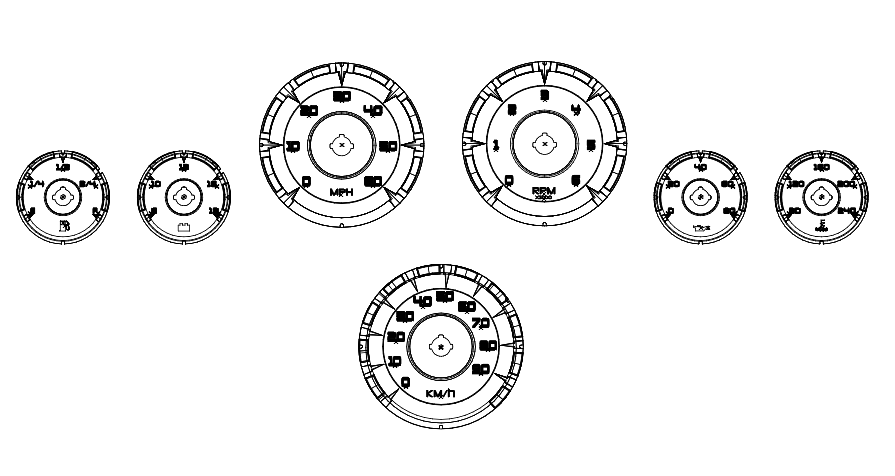
Origin & domain
Built on the production floor — not a portfolio mood board.
Gauges for marine, off-road, on-road, and military industries. Shaped by engineers, fabricators, floor staff, and quality inspectors.
Marine · off-road · industrial · defense-grade instrumentation
Cross-domain logic without automotive lock-in — scalable to OEM platforms
Production-calibrated design problem solving under fabrication and safety constraints
Problem & cost
When hierarchy breaks, operators pay in seconds.
Core failures
- No cultural adaptation
- Hierarchy inconsistency
- Information overload
- Performance vs. navigation conflict
Cost of failure
- Safety risk under motion
- Performance misread at speed
- Internal mapping confusion
Core concept
Dual-Inheritance Falcon System
Two layers keep field-of-vision load focused at high speeds. Performance wraps clarity — hierarchy decides.
Gyrfalcon layer
Legacy · performance complexityRPM · telemetry · dynamic load · inherited mechanical gauge logic on the outer ring.
Saker layer
Foresight · operational claritySpeed · navigation · safety-first hierarchy · directional intelligence at the core.
One area reads. One area decides. Never both competing for the same glance.
Information architecture
Three radial data zones
Navigation dominates at sea. Speed governs ISO compliance. RPM guards against engine stress.
Core · Navigation
Primary at sea — heading, waypoints, celestial cues (stars, sun, moon). Screen dominance with game-HUD waypoint bar logic.
Middle · Speed
ISO-readable motion reference. Speed governs compliance; navigation governs attention.
Outer · RPM
Propulsion load and engine stress — second priority at sea to avert mechanical failure under load.
Information hierarchy
Priority rule system
Cognitive load reduction under motion stress — not decoration under duress.
State-based UI logic
Four operational states
Structure, hierarchy, motion, and density change — not decoration. Triggers: speed · engine load · user input · alerts · zones.
Cruise
No-wake zone · low load · nav priority · reduced noise
Sport
Moderate performance · stabilized radial motion
Performance
RPM dominance · telemetry exposure · motion response
Emergency
Alert override · nav collapse · critical data only
Human factors
Safety-first constraints
Glance rule
Maximum readability under motion — every critical read completes in two seconds.
Always override
Emergency alerts · port · starboard hazards — nothing ranks above safety.
Forbidden at speed
Animation · visual density · ornamental overlays on data layers.
Multi-environment
Desert · marine · night
Marine first — production familiarity lives there. Desert second — contrast logic transfers.
Desert mode
High contrast · sand-tone palette · reduced bloom · heat readability
Marine mode
Deep blue spectrum · horizon overlays · primary entry domain
Night mode
Bioluminescent cyan · low-luminance hierarchy for night helm
Gulf-native · application map
Where the system lives
Arabic-first spatial hierarchy · RTL must never distort radial geometry. Gulf-native by lived context — not imported UX.
Yacht helm
Primary entry — highest domain expertise and production familiarity.
Desert SUV
Second expansion — high-contrast performance clusters.
Autonomous mobility
State-driven UI for NEOM / Red Sea corridor platforms.
Aviation-inspired cockpit
Layered situational awareness · Honeywell-style hierarchy.
Ultimate vision: Islamic dome design integration — biomimetic radial geometry aligned with Gulf architectural intelligence, not surface ornament.